I sat staring at my monitor in complete silence at 2 AM last Thursday. I was grinding a brutally hard Polytrack custom map, and I had a flawless run going. My speed was maxed out. I hit the final massive ramp, slightly over-rotated my car’s nose in the air, and landed upside down directly on the finish line.
The ghost car I was racing just zoomed right past my flipped tires. It easily stole the world record I had been sweating over for three straight hours.
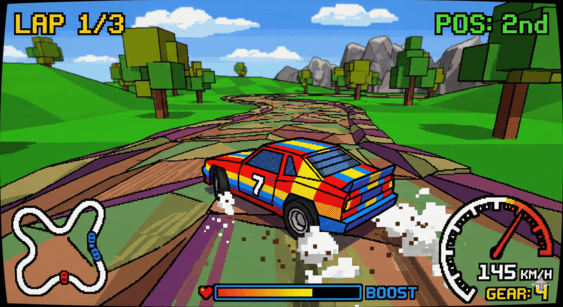
Not gonna lie, that specific brand of intense, heart-crushing frustration is exactly why I cannot stop playing Polytrack. Honestly, it looks like a super simple retro game from the outside. You just drive a little unbranded car on a floating track. But trust me, beneath those charming, old-school graphics hides one of the tightest, most mechanically demanding racing engines on the web right now.
You start out thinking it will be a relaxing little Sunday drive. Two hours later, your eyes are burning, and you are actively calculating suspension physics just to shave three milliseconds off your personal best. Because Polytrack strips away all the boring stuff. There is no open-world traffic to dodge and no annoying gas meters to refill. It is just you, the track, and the timer.
If you are tired of clipping the edge of a wall and losing your speed, we are going to fix your driving habits right now. Let’s look at the actual speedrun meta of Polytrack, how to manipulate the brutal gravity, and why you are definitely pressing the brake pedal way too much.
Drifting Trap
Let’s get one major thing straight right off the bat regarding your speed in Polytrack. Have you ever noticed how your car basically comes to a dead stop when you take a tight corner?
That happens because you are treating the brake button like a panic switch instead of a drifting tool. A lot of beginners boot up Polytrack and hold the brake whenever they see a sharp turn approaching. That makes sense in real life, but it is a terrible habit here. It will absolutely ruin your times on the leaderboards. The physics engine in Polytrack heavily punishes slow driving. You need to preserve your forward momentum at all costs.
Instead of holding the brake, you just need to briefly tap your steering wheel. Do not hold them down. This forces the back end of your car to kick out, initiating a smooth, high-speed slide. But maintaining that slide is where the actual skill gap lives. Because the steering in Polytrack is incredibly sensitive, over-correcting becomes your biggest enemy. If you hold the directional key for just half a second too long, your car will spin out entirely and hit the guardrail.
You have to train your brain to stop panicking. Tiny, deliberate taps on your keyboard are the only way to squeeze through narrow apexes. You want to slide just close enough to the inside wall that your paint almost scratches the concrete, without actually touching it.
Mastering Air Control and Polytrack Suspension
We really need to talk about what happens when your tires leave the asphalt. Hitting a massive ramp at full speed in Polytrack feels totally amazing. But physics simply does not care about your feelings.
If you just launch yourself into the sky and take your hands off the keyboard, you are going to crash violently when you land. In Polytrack, you have total control over your car’s pitch and roll while you are flying through the air. You can use your arrow keys or WASD to tilt your nose up or down, and roll the chassis left or right. Landing perfectly flat is absolutely mandatory if you want to preserve your speed.
Have you ever landed a jump and noticed your car immediately bounced to the left and hit a wall? That happens because your suspension absorbed the impact unevenly. If you land with your right tires hitting the ground a fraction of a second before your left tires, the car’s suspension violently kicks back. You have to adjust your roll in mid-air, so all four wheels hit the track at the same millisecond.
Here’s the thing about those crazy jumps in Polytrack. Sometimes, going as fast as possible is actually a massive trap. There are specific ramps designed entirely to punish greedy drivers. If you hit a medium-sized ramp at top speed, you will completely overshoot the landing zone and fly out of bounds. You actually have to let off the gas pedal right before hitting the lip of the jump. Learning those precise braking points is what separates the casuals from the pros in Polytrack.
Abusing the Polytrack Editor for Hyper-Focused Practice
You know that one specific corkscrew loop on your favorite Polytrack map that always ruins your flawless run? Stop playing the entire two-minute track just to practice that single five-second turn. You are totally wasting your time.
The built-in track editor in Polytrack is absolutely insane. It allows you to snap roads, loops, and boost pads together like digital Lego blocks. Most people just use the editor to build silly, impossible torture chambers to troll their friends online. But veteran players use it as a highly specific training facility.
If a particular corner is giving you trouble in the official campaign, just open the Polytrack editor and recreate that exact piece of road. By building a tiny, ten-second loop featuring the exact curve you struggle with, you can practice it hundreds of times in a row without any downtime. You just hit the respawn button instantly whenever you crash. Once you build up the muscle memory to drift through that custom turn perfectly, you go back to the real map and absolutely destroy your old high score. It is a highly aggressive, deeply nerdy way to practice, but it works flawlessly in Polytrack.
Also Read: Snow Rider 3D – Breathtaking Adventures on Snow Mountains
Chasing Ghost Data on the Global Leaderboards
Playing by yourself gets incredibly boring after a while. The real adrenaline rush comes from chasing down the top players on the Polytrack global leaderboards. But you cannot just race blindly and hope to get a better time.
You need to actively download and race against the top player’s ghost data. A ghost is a translucent, holographic recording of another player’s best run. When you load up a ghost in Polytrack, you get to see exactly what racing lines the world record holder is taking. Do not just try to beat them immediately. Spend a few runs driving slowly behind the ghost, carefully watching where they initiate their drifts and where they let off the gas.
You will quickly notice that the Polytrack pros take wildly different routes than you do. They cut corners aggressively. They intentionally clip their tires on the dirt to change their angle in mid-air. They take jumps at weird, diagonal trajectories to shave off distance. Racing a ghost teaches you the hidden mechanics of the engine that the tutorial completely ignores. Just try not to get tilted when the ghost leaves you completely in the dust on the very first straightaway.
Dealing with Frustration and Respawn Tilt
We all have access to heavy, expensive video games with massive cinematic storylines on our hard drives. So why do we voluntarily subject ourselves to the intense torture of a punishing racing simulator like Polytrack on a random Tuesday afternoon?
It all comes down to the friction of failure. In a traditional competitive shooter, if you die, you have to watch a kill-cam, wait for the spawn points to reset, and physically run back to the fight. It gives your brain time to get bored and quit. Polytrack completely removes that friction from the equation. When you flip your car, the level restarts in literally less than a tenth of a second, and the music doesn’t even stop playing.
Your brain barely has time to register the failure before your engine is revving again. This creates an incredibly potent dopamine loop. You constantly feel like you are just one lucky corner away from beating the stage. But it can also cause massive tilt. If you find yourself angrily holding down the gas pedal and crashing into the same wall ten times in a row, you need to take your hands off the keyboard. Close your eyes, take a deep breath, and reset your mental state before you ruin your own Polytrack muscle memory.
Time to Hit the Asphalt
So there you have it. That is the frustrating, highly rewarding, and insanely addictive reality of shaving seconds off your digital lap times.
It isn’t an open-world driving simulator with a massive storyline. But the sheer adrenaline rush of finally beating a Polytrack ghost car after two hundred failed attempts is totally unmatched.
Next time you open up a new tab to play, remember to stop holding down the brake pedal so hard. Start tapping your steering keys to maintain your drifts, and for the love of everything, make sure your car is perfectly level before you land a jump. Are you ready to test your reflexes? Load up Polytrack, warm up your keyboard fingers, and see if you can finally claim that world record today. Just try not to break your mouse when you inevitably crash into the finish line.